Saturday, October 1, 2011

Murphy's Law

Why is it that when your hubby is out of town, THAT'S when your car gets a flat and your bathroom faucet springs a leak?


Everything is fine, under control. I drove the car on the rim down to a nearby tire center and, thankfully, it could be repaired; so £20 and 30 minutes later, we were back on track for our day. Off to ASDA (the Wal-Mart of Europe). Note to self, don't ever, ever, ever go to ASDA on the first Saturday morning after payday. Oh my gosh, it was a madhouse. 

Yes, I'm shopping at ASDA. What about the sweet little butcher shop, bakery, and produce stand in my town? Not to worry, I still go there for fresh foods. My weekly shop at ASDA is to get the good deals on laundry detergent, light bulbs, paper towels, and so forth.


After the chaos of the Saturday morning shop, we stopped in for a little fundraising tea and coffee morning that a friend had invited us to attend. 

Kids in bathing suits kept running inside from the back-yard kiddie pool
to raid the cake table. Everything was homemade! I tried the lemon cake
with chocolate swirl icing and the mini mincemeat pie. Mmmm.

We got there just as the party was wrapping up, so lots
of the treats were already eaten, but we did get sent home
with a small bag of goodies. I love this cake stand!

This family has a rather large back garden with a small
greenhouse, a vegetable garden, lots of flower borders
and a lawn. Still small by American standards, but it
was very pretty. 

There were actually loads of people and kids at this little
fundraiser, but I was trying to crop them out of my pics.
The fundraiser was for a group called Macmillan. They sponsor a campaign each year called "The World's Biggest Coffee Morning" and that's what my friend was hosting. Macmillan is a group that provides practical and emotional support for cancer patients and their families. 

Oh, and the leaky bathroom sink? I called the landlord and we'll see if she gets back to me. (She's not the most responsive landlord on the planet.) For now, I have two pots and a 9x13 lasagna pan catching drips that are coming through the ceiling below into the back office of our rental house. 

"Daddy Germy"

Well, Daddy was germy, but thankfully he got over his cold just in the nick of time for his scheduled trip to Germany, or as Ollie says, "Germy."

So when Ollie misses Mike he says, "Daddy Germy. Daddy airplane." Cute.

Mike went to Cologne for business back in August, but this trip is 100% fun. He's there for Oktoberfest in Munich with a pal from work (who's from Germany; the guys are staying with his aunt). I know the guys are having a great time--and Mike promises a blog update with pictures when he gets back. Stay tuned for that.

Something funny Merrit said this morning, as he was watching Scooby Doo: "Velma's hair is really messed up." Ah Merrit, truer words were never spoken.

Thursday, September 29, 2011

How to Build a Backyard Den

So, it turns out that in a country where it often rains, it’s essential to have a place to go with your mates that’s neither outside OR inside. This place is called a den. Not unlike a fort or tree house, a den can be fancy or in our case a shanty made from whatever scrap we could find laying about.

STEP 1:  Analyze your materials. What can we use this for? Nothing it turns out...too big, too much work for slapping something together to remove all the planks and nails.


STEP 2: Analyze the potential den site. If nothing else, it gives you an excuse to climb on to things you’re not supposed to.


STEP 3: Make sure you have some kind of roof, because the primary goal is to get out of the rain. This old door should work.


STEP 4: Review the in-progress construction and materials...looks fairly bleak, but the boys seem to like it.


STEP 5: Wonder about smashing things. This is important...it makes the boys feel like they’re building something, even though all they’re doing is breaking wood into kindling and fighting over tools.


STEP 6: Make sure the little ones get involved...Ollie obviously doesn’t approve. He’s thinking: “The roof overhead is full of gaps! When it rains this den will be just as wet as it would be without the rubbish roof! Is this some kind of task engineered for the silly psychological satisfaction of constructing something that has no apparent value other than keeping us busy?!!” Yes Ollie, yes it is.


STEP 7: Get a feel for the den’s potential, spotting problems to be fixed while claiming ownership of the den. Merrit seems hopeful that rain will not come through the giant gaps in the door above.


STEP 8: Get a bunch of girls to tell you how much better their den is. This solidifies a "girls only" den and a "boys only" den. Who cares if they have a fridge! We can throw rocks farther!


STEP 9: When in doubt, add carpet.


STEP 10: Look tough in your new den, it tells everyone to keep out! Secret stuff is going to happen here, secret plans and plotting. Now...we’re hungry. Let’s go inside.


Wednesday, September 28, 2011

"Notes from a Small Island" by Bill Bryson

What I'm reading now.
I could kiss my neighbor for recommending this book! (Then she was sweet enough to send her daughter up the street to loan me her copy.) I've been enjoying it so much, and now that I'm nearly at the end, I'm reading more slowly. Isn't that always a sure sign that you just don't want it to end?

From the back of the book:

After nearly two decades in Britain, Bill Bryson took the decision to move back to the States for a while, to let his kids experience life in another country, to give his wife the chance to shop until 10 p.m. seven nights a week, and, most of all, because he had read the 3.7 million Americans believed that they had been abducted by aliens at one time or another, and it was thus clear to him that his people needed him. 


But before leaving his much-loved home in North Yorkshire, Bryson insisted on taking one last trip around Britain, a sort of valedictory tour of the green and kindly island that had so long been his home. His aim was to take stock of the nation's public face and private parts (as it were), and to analyse what precisely it was he loved so much about a country that had produced Marmite, a military hero whose dying wish was to be kissed by a fellow named Hardy, place names like Farleigh Wallop, Titsey and Shellow Bowells, people who said 'Mustn't grumble', and "Gardeners' Question Time."


I've been loving this book. For one thing, I always love travel writing. Secondly, I feel like I can sort-of get some of the jokes, but since there are also lots of references (especially to famous/infamous Brits) I don't get, I've had fun Googling some of the pop-culture and historical references (see Marmite and Gardeners' Question Time, above!). Thirdly, Bryson is a snarky but endearing writer with a great and very readable style and a sharp wit. And lastly, as an American he's frequently prone to making comparisons that I identify with; so many of the observations he's made are things I've thought as well (like how the English have such a different sense of distance than Americans--who, as Bryson says, "think nothing of driving three hours for a taco.").

On page 19, remembering when he first arrived in the U.K., he writes:

I didn't know anything really, which is a strangely wonderful position to be in. Everything that lay before me was new and mysterious and exciting in a way you can't imagine. England was full of words I'd never heard before--streaky bacon, short back and sides, Belisha beacon, serviettes, high tea, ice-cream cornet. I didn't know how to pronounce "scone" or "pasty" or "Towcester" or "Slough." I had never heard of Tesco's, Perthshire or Denbighshire, council houses, Morecambe and Wise, railway cuttings, Christmas crackers, bank holidays, seaside rock, milk floats, trunk calls, Scotch eggs, Morris Minors and Poppy Day. For all I knew, when a car had an L-plate on the back of it, it indicated that it was being driven by a leper. I didn't have the faintest idea what GPO, LBW, GLC, or OAP stood for. I was positively radiant with ignorance.

I so related to that passage! Funny thing was, about half of the references (and all of the acronyms!) are still lost on me. It made me remember how, when we'd been here just a week or two, I went to the butcher shop and needed help from the man behind the counter telling the difference between a 20-pence coin and a 50-pence coin. Talk about radiant with ignorance!

Tuesday, September 27, 2011

What's Happening to Me?

I had this for breakfast today:


Beans on toast is a staple around here--for breakfast, lunch, or dinner. Or heck, even for a snack. Well, I'm going to chalk this one up to my being low on groceries. :)

Monday, September 26, 2011

Black Currants Are All Coupled Up


One of the first things we noticed when we started buying groceries here was that black currants are in all kinds of foods and drinks. I guess the black currant man needs to take his sales trophy and have a vacation, as Brian Regan would say!

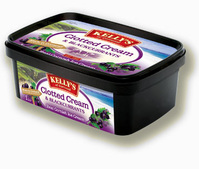
Here's just a sampling of what you find in the grocery aisles here:


        Black Currant Oil 500 mg - 100 Softgels

What is a black currant? It's a little shrub that grows in eastern and northern Europe and in parts of Asia. Turns out that black currant, not native to the U.S., has an interesting past. From Wikipedia:

Blackcurrants were once popular in the United States as well, but became rare in the 20th century after currant farming was banned in the early 1900s, when blackcurrants, as a vector of white pine blister rust, were considered a threat to the U.S. logging industry. The federal ban on growing currants was shifted to jurisdiction of individual states in 1966, and was lifted in New York State in 2003 through the efforts of horticulturist Greg Quinn. As a result, currant growing is making a comeback in New York, Vermont, Connecticut and Oregon. However, several statewide bans still exist including Maine and New Hampshire.

Since the American federal ban ceased currant production nationally for nearly a century, the fruit remains largely unknown in the United States, and has yet to regain its previous popularity to levels enjoyed in Europe or New Zealand. Owing to its unique flavour and richness in polyphenols, dietary fibre and essential nutrients, awareness and popularity of blackcurrant is once again growing, with a number of consumer products entering the market.

Sunday, September 25, 2011

Cragside

Welcome to the country home of Lord Armstrong. Wow, what a country home. While it was built as a two-story country lodge in 1863, it continued to be expanded and improved until Lord Armstrong passed away in 1900. As recently as 2007 - 2008, it was completely refurbished and its famous iron bridge restored to its former glory.
The boys and I on the iron bridge with Cragside in
the background. The path from the house to the bridge
was made up of steep rock stepping stones through
one of (said the guide book) Europe's largest rock gardens.

The rock gardens, on a steep slope down to the iron bridge.

What we already knew about Lord Armstrong is that he was an inventor and major benefactor to industry and philanthropy in England, particularly in the northeast. We learned this when we went to Bamburgh castle, which he bought when it was only partly renovated and finished the renovation.

Armstrong's country home, Cragside, used hydroelectric power to run a laundry machine, a rotisserie, and a hydraulic elevator. It later installed the first hydroelectric power station in the world, which powered a single (!) arc lamp in the gallery. 

Mike and Ollie in the art gallery.
One thing I loved about the interior of Cragside was how it was obvious that Lord Armstrong was a scientist at heart. Actually, it made me think of our little friend back in NC, Andrew, with his moth/butterfly collection in zip-lock bags. :) Armstrong had cases full of his collection of seashells and insects. There were taxidermied specimens of all sorts of birds (I think he particularly liked owls) under cloche jars. 

Seashell collection in case, flanked by birds of prey in cloche jars.
Marble busts and oil paintings, as well as early photographs and even
pen-and-ink caricatures were on display all around the house.
The other thing I really liked about the house was how it was "staged," if you will...as though someone still lived there; for example, opened newspapers and eyeglasses might be out on the side table in the grand room at the end of the gallery (see below). 

This impressive Italian marble fireplace was designed, crafted, transported, and
installed in 18 months to prepare for a visit from the Prince/Princess of
Wales. It weighs 10 tons, and had to be installed directly on top of the
mountain bedrock on which Cragside is built to support its weight.
Examples of this were found throughout the house--wooden toys on the floor in the childrens' rooms, crystal decanters half-full of scotch or some other amber liquid, Armstrong's microscope and specimen slides on the desk in his study--but my favorite signs of life were found in the series of rooms called the plunge bath, which was really about five rooms altogether. 

Going down the stone steps into the plunge bath.

A sauna with a cot for relaxing and fresh towels at the ready.

I'm reading the information sheet with one hand and
keeping Ollie from jumping into the Turkish-inspired
bath with the other.

Many of the objects in this room were souvenirs
from Armstrong's trip to Egypt. This house was
one of the first to have hot and cold indoor
plumbing (see faucet on the wall). 

 After we toured the house, we walked down through the rock garden,


...across the iron bridge,


...down a woodland path and past sheep fields, where we sat on a bench across from this view (below) and listened to the sound of the wind in the tops of the tall conifers, 


...up more stone steps,


...through a rabbit-proof gate,


...past the garden clock tower,


and into the formal garden.


What a view...
It must be said that most of the reason Cragside was so impressive was the weather. After a dreary morning, we packed a car-picnic (which has become our standby rainy day activity) and set off to find a pretty overlook. When we got to the Blyth seafront, the weather sort of lifted and, as we ate hot, sugary donuts from a beachside food truck (what a perfect way to finish off a picnic lunch!), we decided to keep driving north. I used my Trip Advisor iPhone app to see what attractions were nearby. Craigside was only 50 miles northwest. We were off.

The further north we drove, the more gorgeous the day became. We kept going up in elevation as we drove inland until we had just amazing panoramic views of sheep fields, cow pastures, and farmland crisscrossed with hedgerows and the most unreal expanses of sky. These are pictures taken from our moving car:


Related Posts Plugin for WordPress, Blogger...